Showing posts with label Frank Niro. Show all posts

Thursday, September 25, 2014

One Month to go for new Journal Launch

Above: Frank Niro, Managing Editor of the Journal of Chess Research, reviews the manuscript, specifications and pricing of the special preview issue of the new journal with Misti Drury, customer service representative for the printing company.

Article courtesy of the International Society for Chess Research

The new Journal of Chess Research will be released at a special ceremony in St. Louis on October 26, 2014. The date coincides with the 100th anniversary of the birth of Dutch psychologist, Dr. Adriaan de Groot, who is considered around the world as the “father of chess research.” Approximately 40 guests will attend the ceremony, including at least a dozen members of the journal’s prestigious editorial board, as well as representatives of the world governing body of chess (FIDE), educators, and chess leaders from around the United States.

The Journal of Chess Research is the first international scholarly journal that focuses on research related to the game of chess across all academic disciplines. In a recent interview concerning the new journal, managing editor Frank Niro, speaking for the entire editorial team stated, “We are pleased and honored to be selected by the Board of Directors of the International Society for Chess Research to spearhead the launch of this new scholarly publication. We sincerely believe that the journal will appeal to an international audience and will fill a niche in the academic marketplace.”

The new journal plans to publish original theoretical and empirical research based on a variety of perspectives and disciplines - offering a platform for exploring a wide range of chess-related topics including education, psychology, computers, aging issues, cheating, social capital, business strategy, cognitive development, intergenerational awareness, leadership, and statistics. “Beyond that,” Niro said, “it is our hope to work as a stimulus for interest and resources that will trigger further research into health-related topics such as Attention Deficit Hyperactivity Disorder (ADHD), Autism and Alzheimer’s Disease.”

It is no coincidence that the journal is launching with a “preview issue” on the 100th anniversary of the birth of Dr. Adriaan de Groot. Not only was he the chess research pioneer who analyzed how chess players approach problem solving in the 1930s; he was a key member of the IBM project team in the 1990s that developed the chess playing algorithm for Deep Blue, the multi-processer computer that defeated World Chess Champion Garry Kasparov. And for the 60 years in between, he continued to refine his research, publish his results, study, teach, play chess, and even produce his own CD of piano improvisations.

The Journal of Chess Research is the official publication of the International Society for Chess Research. For more information, please consult the journal website: http://www.chessresearch.org/
Mailing address: Journal of Chess Research, 3735 Palomar Centre Drive, Suite 150, Lexington, KY 40513

Membership and subscription information is on the Society for Chess Research website: http://www.chessresearchsociety.org/
Mailing address: Society for Chess Research, P.O. Box 93, Wellston, Ohio 45692

JOURNAL OF CHESS RESEARCH EDITORIAL BOARD MEMBERS

William M. Bart, PhD, University of Minnesota
Jana M. Bellin, MD/WGM, Sandwell General Hospital (England)
Arthur Bowman, PhD, Norfolk State University
Ian Brooks, PhD/ICCF GM, University of Illinois
Christopher Chabris, PhD, Union College
George A. Dean, MD, University of Michigan
Robert Ferguson, PhD, American Chess School
Fernand Gobet, PhD, University of Liverpool (England)
Guillermo Isidron, MD, University of Havana (Cuba)
Gyorgy Kende, DMS, National University of Public Service (Hungary)
Kenneth A. Kiewra, PhD, University of Nebraska
Danny Kopec, PhD/IM, Brooklyn College
Tamara V. Korenman, PhD, Saint Xavier University
Yona Kosashvili, MD/GM, University of Tel Aviv (Israel)
Peter Maher, PhD, Webster University
Alexander Matros, PhD/IM, University of South Carolina
Joseph G. Ponterotto, PhD, Fordham University
Kenneth W. Regan, PhD/IM, SUNY Buffalo
Alexey Root, PhD/WIM, University of Texas at Dallas
Graham D. Rowles, PhD, University of Kentucky
Loren Schmidt, PhD/FM, Heritage University
Julian Z. Schuster, PhD, Webster University
Balint Sztaray, PhD, University of the Pacific
Martha Underwood, PhD, University of Arizona
Ravi Varadhan, PhD, Johns Hopkins University

ADVISORY BOARD MEMBERS

Grandmaster Lev Alburt, New York, NY, author, chess teacher, former U.S. Champion
Ms. Amy Bowllan, Concordia University, NYC, Emmy winning journalist
Dr. Neil Charness, Florida State University, active researcher on chess and aging issues
FIDE Master Leontxo Garcia, Madrid, Spain, international chess journalist
Grandmaster Efstratios Grivas, Athens, Greece, FIDE Trainer’s Commission
Prof. Manuel Guillermo Nieto, Colombia (SA) Sch. of Engineering, International Arbiter
Grandmaster Susan Polgar, Webster University, former women’s World Champion
Grandmaster Ken Rogoff, Harvard University, Cambridge MA, former U.S. Champion

Monday, April 28, 2014

"Journal of Chess Research" launches this fall


Quote of the Day - "All too often in the international chess community many benefits of chess are assumed without any empirical research to support such claims. The problem is that there is a definite need to collect data systematically to determine what all of the benefits of chess are. The international chess community is in the enviable position to foster much needed research on chess and its many benefits." - William M. Bart, PhD, University of Minnesota


A new peer-reviewed academic magazine known as the Journal of Chess Research will be begin publication later this year with support from the Susan Polgar Foundation. As a result, empirical research that tests, extends or explores current theory concerning the benefits and scientific implications of the game of chess will be available in a single location.

Presently, there are no scholarly journals that relate specifically to chess research. Previous articles concerning chess research have appeared sporadically in other disciplines and many of these important articles have not been translated into English. Some researchers have remarked that little has been accomplished with respect to scientific research in chess, and what has been done is difficult to identify and retrieve. The articles that do exist continue to be fragmented, poorly cross-referenced and are not centrally indexed to facilitate review and further research. The Journal of Chess Research will bridge that gap.

William M. Bart, PhD, professor of Educational Psychology at the University of Minnesota, is known in the chess world as co-author of the 2003 “Functional MRI study of high-level cognition. I. The game of chess,” published in Cognitive Brain Research, 16, 26-31. Currently, Dr. Bart teaches a college level course entitled “Chess and Critical Thinking.” In accepting his appointment to the 20-member Editorial Board of the new Journal, he remarked:
"All too often in the international chess community many benefits of chess are assumed without any empirical research to support such claims. The problem is that there is a definite need to collect data systematically to determine what all of the benefits of chess are. The international chess community is in the enviable position to foster much needed research on chess and its many benefits."

As a result of these factors, a new world-wide organization known as the International Society for Chess Research (ISCR) has been formed. The
Journal of Chess Research has been designated as the official publication of the new group and will be available to all ISCR members as part of the annual membership fee.

The Journal of Chess Research will be published quarterly in Lexington, Kentucky, and distributed to university libraries, academicians, chess players, researchers and other interested parties both in printed and electronic formats. Each issue is intended to contribute broadly to awareness and understanding of the impact of chess on human development, psychology, cognition, philosophy, sociology, aging, business strategy, education and technology. Manuscripts that make strong empirical and theoretical contributions to the field of chess-related research will be solicited from scholars throughout the academic community, both in the United States and abroad, and will not be tied to any particular discipline, level of analysis or national context.

The Editorial Board, consisting of distinguished educators and physicians from five different countries, will review all articles in advance in order to ensure that contributions to the field meet rigorous academic standards, exhibit technical competence by researchers and topical relevance. Literature reviews will be accepted, at least initially, to generate a meaningful overview of the current status of chess research on a variety of topics such as chess in education, chess and mathematics, chess and cognitive development, chess and self esteem, chess and Alzheimer’s Disease, etc. Articles not previously available in English may also be accepted, if appropriate.

According to Dr. Joseph Ponterotto of Fordham University, also a member of the Journal’s Editorial Board, “The Journal of Chess Research will be open to multiple methodologies, including qualitative research, field and case studies, life story analysis and so forth, in addition to traditional quantitative and experimental research in various combinations. Many chess studies previously published in cognitive and experimental psychology journals are difficult to understand for the average student and scholar of chess research. The articles in the new journal will be published with the goal of being accessible and reader-friendly, to the extent possible, to a wide audience."

In addition, the Journal of Chess Research will provide an information and referral network to connect researchers and learners and to assist those seeking results and interpretations of research findings. This network will be supported by an interactive and engaging web site, scheduled to be unveiled in June, where profiles of personalities involved with chess research and links to copies of articles from all over the world will be available for examination and download.

Frank Niro, President of Chess Journalists of America, will serve as the Managing Editor of the new publication. Mr. Niro is a member of the adjunct faculty at Cornell University where he teaches Strategic and Business Planning in the Graduate Health Administration program. He is former President of the U.S. Chess Trust and is an award winning writer and editor.

Relevant articles between eight and twenty-five pages that conform to the style guidelines contained in the Publication Manual of the American Psychological Association, 6th Edition (APA-6) will be accepted on an ongoing basis. For articles written in a language other than English, abstracts that are translated into English may be submitted. If accepted for publication, the editorial staff will work with the author to get the entire article translated and consistently formatted.

All papers will be reviewed by the Editorial Board and notifications of acceptance will be made to the authors within 30 days of submission. Following acceptance, authors will be given an additional 15 days to submit a final manuscript. Deadlines for receipt of manuscripts for upcoming issues are as follows: Preview Issue – May 9th; Issue #1 – August 8th; Issue #2 - November 7th; Issue #3 – February 6th; Issue #4 – May 8th; Issue #5 – August 7, 2015.

Manuscripts should be attached in a Microsoft Word document and transmitted via e-mail with the subject heading Journal of Chess Research to the Managing Editor: editor@chessresearch.org. Charts and images should be compatible with Adobe Design Standard CS6 software such as InDesign, Photoshop and Illustrator. The Journal of Chess Research will be available in both print and digital formats. No fees will be charged to potential contributors.

Inquiries concerning membership in the International Society for Chess Research, proposals, abstracts, web site content and other matters should be mailed to the publication office at: Journal of Chess Research, 3735 Palomar Centre Drive, Suite 150, Lexington, KY 40513.

Click on image to enlarge.

BENEFITS OF CHESS


The Benefits of Playing Chess, according to information collected by the Susan Polgar Foundation are as follows:

Improved test scores and academic achievement
Better mental clarity and overall health
Verbal reasoning skills as well as numerical aptitude
Enhanced creativity, concentration and critical thinking
Increased confidence and self-esteem
Development of memory skills
Ability to patiently plan ahead
Understanding the consequences of actions taken
Perceiving a situation from the other person’s perspective


The Cognitive Benefits of Chess are listed below:

Develop analytical, synthetic and decision-making skills, which young people can transfer to real life.

Learn to engage in deep and thorough chess research to help build confidence in their ability to do academic research.

Help children gain insights into the nature of competition which will help them in any competitive endeavor.

When youngsters play chess they must call upon higher-order thinking skills, analyze actions and consequences, and visualize future possibilities.

In countries where chess is offered widely in schools, students exhibit excellence in the ability to recognize complex patterns and consequently excel in math and science.

The above information concerning the benefits of chess was presented at the SPF fundraiser at the Hungarian Consulate in New York City, May 2013.

Journal of Chess Research web site

International Society for Chess Research web site

Announcement on Susan Polgar Daily News and Information

Chess Benefits in all areas!

regator.com backlink

LIST OF EDITORIAL BOARD MEMBERS

Saturday, January 4, 2014

Latest McKay Tartan book series update

No. 21, Listen for the Lonesome Drum, another of the non-chess books in the David McKay Tartan series

I have now acquired and/or identified 71 of the 73-book Tartan Series. My goal in 2014 is to locate the remaining two books. I am missing numbers 16 and 45.

1. Ideas Behind the Chess Openings – Reuben Fine
2. The Middle Game in Chess – Reuben Fine
3. Basic Chess Endings – Reuben Fine
4. Learn Chess Fast – Sammy Reshevsky & Fred Reinfeld
5. My System – Aron Nimzovich
6. Common Sense in Chess - Emanuel Lasker
7. Winning Chess Traps - Irving Chernev
8. Chess Strategy & Tactics - Fred Reinfeld & Irving Chernev
9. Modern Chess Strategy - Edward Lasker
10. Let’s Play Checkers - Grover & Wiswell
11. Learn Checkers Fast - Tom Wiswell
12. Pawn Power in Chess - Hans Kmoch


13. Prodigal Genius: the life of Nikola Tesla - John J. O'Neill
14. Freud: A Critical Reevaluation of his Theories - Reuben Fine
15. The Canterbury Tales - Geoffrey Chaucer; Frank Ernest Hill
16. ?
17. The Commonsense Book of Wine - Leon Adams
18. My Best Games of Chess 1908-1923 - Alexander Alekhine
19. My Best Games of Chess 1924-1937 - Alexander Alekhine
20. Dark Trees to the Wind - Carl Carmer

No. 20, Dark Trees to the Wind, tales about life in NY

21. Listen for a Lonesome Drum - Carl Carmer
22. The Playmaker of Avon - Charles Norman
23. English Thought in the Nineteenth Century - D.C. Somervell

24. English Social History - George Trevelyan
25. 200 Miniature Games of Chess - J. du Mont
26. A Passion for Chess - Reuben Fine
27. Chess Fundamentals - J. R. Cabaplanca
28. The Art of Sacrifice in Chess - Rudolf Spielmann
29. Profile of a Prodigy - Dr. Frank Brady
30. Storming of the Gateway - Fairfax Downey
31. Point Count Chess - I.A. Horowitz & Geoffrey Mott-Smith
32. Paul Morphy and the Golden Age of Chess - William Napier
33. Epic Battles of the Chessboard - R.N. Coles
34. Alekhines' Best Games of Chess 1938-1945 - C.H.O'D. Alexander
35. Dominoes - Dominic Armanino
36. How to Win in the Chess Endings - I.A. Horowitz
37. Practical Chess Openings - Reuben Fine
38. Strategy and Tactics in Chess - Max Euwe
39. Beginning Backgammon - Tim Holland
40. Official Rules of Chess - U.S. Chess Federation
41. Chess Master vs. Chess Amateur - Max Euwe & Walter Meiden
42. Monopoly Book - Maxine Brady
43. Guide to Tournament Chess - Siegbert Tarrasch
44. The Game of Chess - Siegbert Tarrasch
45. ?

46. Official Rules of Chess (2nd edition) - Martin Morrison, editor
47. The Development of Chess Style - Max Euwe
48. Capablanca's 100 Best Games of Chess - Harry Golembek
49. Modern Chess Opening Traps - William Lombardy
50. The Road to Chess Mastery - Max Euwe & Walter Meiden
51. Pawn Structure Chess - Andrew Soltis
52. The World Chess Championship 1978 - Bent Larsen
53. Backgammon for People Who Hate to Lose - Tim Holland


54. Better Backgammon - Tim Holland
55. Attack and Defence in Modern Chess Tactics - Ludek Pachman
56. Judgment and Planning in Chess - Max Euwe
57. Modern Chess Tactics - Ludek Pachman
58. The Art of Positional Play - Samuel Reshevsky
59. The Chess Struggle in Practice - David Bronstein
60. Winning Casino Craps - Edwin Silberstang
61. Maxims of Chess - John Collins
62. Catalog of Chess Mistakes - Andrew Soltis
63. A Short History of Chess - Dr. Henry Davidson
64. Learn to play Mah Jongg - Marcia Hammer
65. Winning Poker Strategy - Edwin Silberstang
66. Practical Endgame Lessons - Edmar Mednis
67. The Modern Chess Sacrifice - Leonid Shamkovich
68. America's Chess Heritage - Walter Korn
69. Modern Chess Openings - Walter Korn
70. King Power in Chess - Edmar Mednis
71. The Art of Defense in Chess - Andrew Soltis
72. How to play good Opening Moves - Edmar Mednis
73. U.S. Chess Federation's Official Rules of Chess - Tim Redman, ed.

Thanks to those who have assisted me with this list including Patsy A. D'Eramo, David Shane, Robert Chenault, Robert Hampton, Dale Wentz and especially my wife, Natasha Niro.

Previous posts about this series:
Books 1-3, April 17, 2008
Book No. 4, May 22, 2008
Book #5 + list, September 19, 2011
2012 Update, November 8, 2012
Tartan Book Series, August 15, 2013


Friday, January 3, 2014

What do Cashew Chicken and Pink Floyd have in common?


I posed this question on ask.com and, surprisingly, got some answers. Boiled down, it's: "How can you hate either one?"

The combination "cashew chicken + pink floyd" on Google.com returned Leong's Asian Diner in Springfield, MO, and Tiffany's profile on airbnb.com and about 813,000 other results (no kidding!). Makes little difference if you enter it as "pink floyd + cashew chicken" (except that there are a few thousand more hits).

Anyway, the answer is chess. Come back this weekend to find out why...


And for those who are looking for something reasonably priced and a little different to do later this month, consider this as an option:


Please go here for my 2013 blog index sorted by topic.

Friday, December 27, 2013

E-town Christmas Open is tomorrow; PanAm starts at TTU in Lubbock


When I was living in Oregon, one of the local organizers (H.G. Pitre) suggested a series of chess tournaments starting around noon rather than 9 AM or 10 AM so that, among other reasons, it would be more convenient and less expensive (one less night in a hotel) for players traveling a long distance to the event. I found his suggestion intriguing and told him that I would give it a try in the Pacific Northwest at some point in the future. In the meantime, I moved away before I could fulfill my promise. But it remains on my "to do" list.

Interestingly, tomorrow will be my second tournament in Kentucky this month and both have had mid-day start times for round 1. I like it!

Elizabethtown, the site of tomorrow's tourney is an hour and a half 85-mile trek down the Bluegrass Parkway. It's a beautiful drive, but not one I that would enjoy as much if I had to get up at six o'clock on a Saturday morning.

Here's the link to the tournament flyer.

Of course, where I would really like to be heading this weekend is the Pan American Intercollegiate Championship in Lubbock, TX, with the Cornell University Chess Team. Cornell recently won the Eastern Team Championship for the second year in a row and, last February, finished in second place in the U.S. Amateur Team East (aka the World Team Championship). The players have been working with GM Alex Yermolinsky via Skype, so I think they would be competitive at Texas Tech.

<-- TTU Chess Program Director, Al Lawrence, and "friend" promoting the Pan American Intercollegiate Chess Championship in Lubbock, Texas, December 27-30. The top four teams will advance to the Final 4 of College Chess next Spring.


Sadly, the team members could not get any funding from the university and were told that they could not use their student activity money during the school break. It's an absurd rule but, apparently, it is the result of past abuses by other students not related to the chess team. I feel badly for the students and wish I had the resources to write them a check myself. As a result, there will be no Cornell team in Lubbock this year. I am very disappointed, as I know that the coach and the players (and tournament organizer Al Lawrence) are as well.

The program for the 2013 Pan American Intercollegiate Chess Championship can be downloaded here.

42 teams are entered this year. Defending Final Four Champion Webster University (Webster Groves, MO) is seeded #1 with a 2770 average rating, followed by Texas Tech at 2646 and University of Texas at Dallas at 2633.
PanAm Pairings and Results

The games from the PanAm can be watched here.

With respect to my last tournament, I finished 2-1 and gained a few rating points. The tournament was played at Expansive Art in Lexington on December 7, a one-day 3-rounder that is part of a first-Saturday-of-the-month series. This particular tournament became known as "Weekend Ice Storm" for reasons that would have been obvious to anyone in attendance. My favorite game was against Eric Martin because it ended with an unusual bishop + knight mate against my opponent's exposed king.

Frank Niro vs Eric Martin [B13]
Lexington, KY (2), December 7, 2013
Caro Kann Defense, Exchange Variation


1.e4 c6 2.d4 d5 3.exd5 cxd5 4.Bd3 Nc6 5.c3 Nf6 6.Bf4 Qb6 7.Qc2 Bd7 8.Nf3 0-0-0 9.Nbd2± h6 10.h3 Nh5 11.Bh2 g5 12.g4 Ng7

12...Nf4!

13.Qb3 Qxb3 14.axb3! f6 15.b4+- e5 16.b5

16.dxe5 Nxe5 17.Nxe5 fxe5 18.0-0 Bd6 19.Rxa7±

16...e4 17.Bxe4

17.bxc6 Bxc6 18.Bc2 exf3 19.Rxa7 Bd6 20.Bxd6 Rhe8+ 21.Kd1 Rxd6 22.Nxf3±

17...dxe4 18.Nxe4 Re8

18...Nb8 19.Rxa7 Ne6 20.c4

19.Nfd2 f5 20.gxf5 Bxf5 21.f3 Nd8 22.Rxa7 Nh5 23.Be5

23.Kf2!?

23...Rh7 24.Nc4 Bxe4?

24...Kd7 25.0-0 Bxe4 26.fxe4 Nf4 27.Nb6+ Ke6 28.Bxf4 gxf4 29.Rxf4 Rg7+ 30.Rg4 Rxg4+ 31.hxg4± Be7 32.Kg2

25.Nb6# 1-0


FINAL POSITION: Niro-Martin, Lexington, KY, December 7, 2013

SUPPLEMENTAL GAMES: For those interested in this particular opening variation beginning after 6...Qb6, following are a few previously unpublished games from my personal database...

Note: ratings are correspondence ratings

Niro,F (2027) - DiLucente,T (1847) [B13]
ASPCC, 10.03.2000

1.e4 c6 2.d4 d5 3.exd5 cxd5 4.Bd3 Nc6 5.c3 Nf6 6.Bf4 Qb6

Position after 6...Qb6

7.Qc2 g6 8.Nd2 Bf5 9.Bxf5 gxf5 10.0-0-0 e6 11.Re1 Rc8 12.Qxf5 Be7 13.Qh3 Nxd4 14.Be3 Qb4 15.Kd1 Rxc3 16.bxc3 Qa4+ 17.Nb3 Nxb3 18.axb3 Qxb3+ 19.Ke2 Qc4+ 20.Kf3 Qe4+ 21.Ke2 Qc4+ 22.Kf3 Qe4+ 23.Ke2 Qc4+ 24.Kd1 Qb3+ 25.Ke2 Qc4+ 26.Kf3 ½-½

Niro,F (2050) - Easley,D (2216) [B13]
ASPCC 2001, 25.01.2001

1.e4 c6 2.d4 d5 3.exd5 cxd5 4.Bd3 Nc6 5.c3 Nf6 6.Bf4 Qb6 7.Qc2 Bg4 8.Nd2 Rc8 9.Ngf3 e6 10.0-0 Bh5 11.Qb3 Qxb3 12.axb3 Bg6 13.Be2 Nh5 14.Be3 Bd6 15.b4 a6 16.Nb3 Rb8 17.b5 axb5 18.Bxb5 0-0 19.Nc5 Bxc5 20.dxc5 Nf6 21.b4 Ne4 22.Ra3 Ra8 23.Rfa1 Rxa3 24.Rxa3 0-1

Niro,F (2117) - London,A (1690) [B13]
Gameknot.com, 20.12.2009

1.e4 c6 2.d4 d5 3.exd5 cxd5 4.Bd3 Nc6 5.c3 Nf6 6.Bf4 Qb6 7.Qb3 Qxb3 8.axb3 e6 9.Ne2 Be7 10.0-0 0-0 11.b4 Bd7 12.b5 Nd8 13.Nd2 b6 14.Ra2 Ne4 15.Nxe4 dxe4 16.Bxe4 Rc8 17.Bd3 1-0

Niro,F (2103) - Briggs,J (2040) [B13]
Gameknot.com, 02.12.2009

1.e4 c6 2.d4 d5 3.exd5 cxd5 4.Bd3 Nc6 5.c3 Nf6 6.Bf4 Qb6 7.Qc2 g6 8.Nd2 Nh5 9.Be3 Qc7 10.Ne2 Bg7 11.0-0 0-0 12.Rae1 Bd7 13.f4 Rfc8 14.a3 e6 15.Nf3 Qb6 16.Nc1 Ne7 17.Qb3 Nf6 18.Ne5 Be8 19.Qxb6 axb6 20.g4 Ne4 21.Kg2 f6 22.Nf3 Ra5 23.Re2 Ba4 24.Rfe1 Raa8 25.Bf2 f5 26.h3 Rc7 27.Bg1 Nc8 28.Ng5 Re7 29.Na2 Ncd6 30.Nb4 Rf8 31.Bh2 Bb3 32.Bb1 Nc4 33.Nd3 Rc8 34.Bg3 Ree8 35.Bh4 Rc7 36.Nc1 Ba4 37.Nd3 Bb5 38.gxf5 gxf5 39.Nf3 Kh8 40.Kh2 Rg8 41.Rg2 Bh6 42.Rxg8+ Kxg8 43.Re2 Rg7 44.Bg5 Bxg5 45.fxg5 Nxg5 46.Nxg5 Rxg5 47.Nf4 Bd7 48.Bd3 Kf7 49.Bxc4 dxc4 50.d5 exd5 51.Nxd5 Be6 52.Nf4 Bd7 53.Nd5 Be6 54.Nxb6 f4 55.Rf2 Rf5 56.a4 Kf6 57.Rf1 h6 58.h4 Ke5 59.Kg2 Rh5 60.Rh1 Kf5 61.a5 Kf6 62.Rd1 Rxh4 63.Nd7+ Ke7 64.Nc5 Rh5 65.Nxe6 Kxe6 66.Rd4 Rxa5 67.Rxc4 Rb5 68.b4 Rf5 69.Kf3 h5 70.Re4+ Kf6 71.Re8 b5 72.Rg8 Kf7 73.Rg1 Ke6 74.Rg6+ Kd7 75.Rg7+ Kc6 76.Rg6+ Kd5 77.Rb6 Kc4 78.Rc6+ Kd5 79.Rb6 Kc4 80.Rc6+ ½-½

Niro,F (1914) - Simi,J (1901) [B13]
Gameknot.com, 05.10.2009

1.e4 c6 2.d4 d5 3.exd5 cxd5 4.Bd3 Nf6 5.c3 Nc6 6.Bf4 Qb6 7.Qc2 Bg4 8.Nd2 e6 9.Ngf3 Be7 10.0-0 Rc8 11.Qb3 Qxb3 12.axb3 a6 13.h3 Bh5 14.Rfe1 Bg6 15.Be2 h6 16.b4 0-0 17.b5 axb5 18.Bxb5 Ne4 19.Bxc6 bxc6 20.Ne5 Nxd2 21.Nxg6 fxg6 22.Bxd2 Kf7 23.Ra6 Bd6 24.b3 Ke7 25.c4 dxc4 26.bxc4 Kd7 27.Rb1 Rb8 28.Ra7+ Bc7 29.Rxb8 Rxb8 30.Bf4 Rc8 31.Be5 Kd8 32.Bxg7 Rb8 33.Bf6+ Kc8 34.Rxc7+ Kxc7 35.Be5+ Kb7 36.Bxb8 Kxb8 37.c5 Kc7 38.Kh2 Kd7 39.Kg3 Ke7 40.Kf4 Kf6 41.h4 h5 42.Ke4 Ke7 43.Ke5 1-0

Wish me luck tomorrow! And good luck to all the teams at the 2013 Pan American Intercollegiate tournament in Lubbock, TX.

Tuesday, December 24, 2013

Merry Christmas and Happy New Year


Tash and I wish you all a wonderful Christmas, a joyous holiday season, and a happy and healthy new year in 2014! Below is our annual open letter to our family and friends. We especially miss our children and grandchildren who, this year, are all far away from our temporary home in Kentucky.

Dear family and friends,

Greetings from Kentucky! This Christmas marks the 4th different state in which we have celebrated the holidays in four years. In 2010 we were in our beautiful historic home in Oregon City. 2011 brought us to Ithaca, NY, and the campus of Cornell University. Last year we made it back to Meridian, Idaho, to celebrate with Tash's parents: Gene & Celeste Fox.

The end of 2013 finds us in Lexington, far away from where we began our “adventure of a lifetime” in Oregon. We packed up the Conestoga wagon (aka Penske truck) in late June and made our way across the country (by late July) so Tash could begin doctoral studies at the University of Kentucky in the Graduate Center for Gerontology. (You may have heard of UK…they have a little basketball team here.) The first school term is successfully finished, with Tash’s sanity (mostly) still intact. Her winter break will be filled with reading, catching up on Downtown Abbey, and trying to bring order to her messy office.

Adjusting from life in the Northwest has gone fairly smoothly, though Tash still freaks out when there is a tornado warning. Of course, we were able to follow the Red Sox through the World Series, so we felt on solid ground. There’s no beach or Dungeness crab, but the barbecue is really good here so it’s hard to fuss too much! The countryside is absolutely beautiful, with its great expanses of green pastures bounded by mile after mile of freshly painted horse fences.

We can hardly wait until Spring to see what all the fuss over "bluegrass" is about. There are plenty of walking trails so we have no excuse NOT to exercise. Weather permitting, Frank walks/runs 2 miles per day.

But MOST OF ALL, we miss those with whom we share love. Visitors welcome!!"


Thursday, November 21, 2013

You Never Know Where Hope Grows


This past Tuesday I was an extra in a third different scene for the upcoming movie, Produce. I am pictured above chatting with cast member, McKaley Miller, after the scene at Mt. Tabor Cemetery in Crestwood, KY. Interestingly, Mt. Tabor is the final resting place of D.W. Griffith, know as the "father of the motion picture."

Scheduled to be released in late 2014, progress can be monitored on the movie's website IamProduce.com.

My earlier blog concerning the movie including a plot synopsis is located here.

Thursday, June 6, 2013

An afternoon chat with Yasser - Part I

Quote of the day: "Lkhamsürengiin Myagmarsüren", he said. Not quite able to understand what he just heard, Bobby looked up and asked once more. "Lkhamsürengiin Myagmarsüren," his opponent repeated. This went on for a third time after which Bobby just shook his head and wrote A. Mongolian on his score sheet.


Chess Grandmaster Yasser Seirawan and Frank Niro at 2012 US Open in Vancouver, WA. Photo courtesy of Al Lawrence.

Recently, I had the opportunity to chat with American Grandmaster Yasser Seirawan, originally from Seattle. Yasser currently splits his time between the Netherlands and St. Louis, where he spends about a third of the year as temporary Grandmaster-in-residence at the St. Louis Chess Center and coach of the Lindenwood University chess team. Following is part one of my interview with him on May 21, 2013 in St. Louis.

Frank:


Thank you, Yasser, for taking the time to meet with me here in St. Louis. I enjoyed the tennis court photo of you and Robert very much. Tell me, please, about your relationship over the years with Grandmaster Robert Byrne.

Yasser:

I met Robert for the first time I believe around 1980 when we played in a U.S. Championship together. And then I knew him very well during the 80s and 90s period. For example, the tennis picture you asked about was taken by Lars Grahn. They were published originally in the Swedish magazine, Schacknytt, which Lars published for about 20 years. Robert and I were playing tennis during the 1981 Karpov-Korchnoi match in Merano, Italy. Lars took a lot of photos and also added some things. There is one where my racket is fully extended, Byrne is close to the net, and the ball is landing behind me. And Lars has drawn these dots where the ball hits my racket and goes over my head. He did it very nicely.

Robert in those days, of course, was a columnist for The New York Times. He took his job extremely seriously. When he was on a deadline, he really focused. And when you think about his column and what he achieved, it is remarkable consistency. Take a thousand of these articles, from the first to the thousandth, just fantastic! I think today folks really don’t know how good he was at what he did. The Times, beyond the column that he had, would periodically give him space to write about the world championships that he was covering. So he wrote massive articles about Korchnoi-Karpov, Kasparov-Karpov, and all of those matches that he attended. It was a remarkable effort on his part for a very long period of time.

We had a really good relationship. I thought of him, in a way, as a very classical man, a man of great dignity, a cultured man. He was extremely well mannered. I remember, in 1995, we were at the Kasparov-Anand match in New York City in the twin towers, where the match was held. We were staying at the hotel at the very bottom of the towers, as were he and his wife. We had gone out to dinner. Our table was prepared, everything was really nice. But before we sat down, he went to his wife’s seat and pulled back her chair. It’s just nice, old world manners, nothing to do with sexism or political correctness or any of that nonsense. It was just the way he was raised and what he did, how gentlemen behaved. It made an impression so much so that I’m telling you about it now.

He was, as you know from your own experience with Robert, a great raconteur. It was very surprising because, in his column, he shied away from that. He wrote matter-of-factly: "this is what happened, and… white lost on time." But how white lost on time, and all the stories and the politics, he never got into that. When the gloves were off and he could tell stories, however, we would laugh so hard and have such good times! It’s a shame that the general public didn’t often get to see that side of him.

He told me lots of stories about Bobby Fischer, which I just loved. One, in particular, I really liked he was in Buenos Aires, Argentina, for the Petrosian match. It is game seven of the match, and Fischer has a slight 3.5-2.5 lead. The winner will play Boris Spassky for the world championship in 1972. At move 22 he surprised many GMs by forsaking his strong knight outpost to take an underperforming bishop.

Robert J Fischer – Tigran Petrosian [B42]

Candidates Match Buenos Aires ARG (round 7), October 19, 1971
1.e4 c5 2.Nf3 e6 3.d4 cxd4 4.Nxd4 a6 5.Bd3 Nc6 6.Nxc6 bxc6 7.0–0 d5 8.c4 Nf6 9.cxd5 cxd5 10.exd5 exd5 11.Nc3 Be7 12.Qa4+ Qd7 13.Re1 Qxa4 14.Nxa4 Be6 15.Be3 0–0 16.Bc5 Rfe8 17.Bxe7 Rxe7 18.b4 Kf8 19.Nc5 Bc8 20.f3 Rea7 21.Re5 Bd7


Robert Bryne described the scene as follows: “White had a dominating knight on c5, and Petrosian had this stupid looking bishop on d7. And Bobby took the bishop.”

22.Nxd7+

“In the media center, there was pandemonium,” Robert said. Grandmaster Miguel Najdorf was holding court, and he just started shouting: “My God, what an idiot! How could he give up this fantastic knight for the stupid bishop? He knows nothing, nothing about chess.” “The Soviets,” Byrne recalled, “were all smiling because they understood that Bobby had made an egregious strategic error.”

Everybody turned to Robert Byrne and asked his opinion. “I’m working on my story for the match and can’t answer right now,” he said. Later, when telling Yasser this story, he explained, “I knew Bobby Fischer very well and I knew how he played chess. Bobby loved his bishops and by capturing that bishop, in Bobby’s mind, he was just putting the nail into Tigran’s coffin. While I wasn’t sure it was a good move, I knew that Bobby was happy making that move and would do it 100 times out of 100.”

“Well, the game progressed and, as it progressed, everything was like a dream, a boa constrictor. Move after move after move Bobby’s position improved and Tigran’s got worse. The next thing you know, Bobby had two rooks doubled on the seventh, a dominating bishop, excellent king and Petrosian had to resign.”

22…Rxd7 23.Rc1 Rd6 24.Rc7 Nd7 25.Re2 g6 26.Kf2 h5 27.f4 h4 28.Kf3 f5 29.Ke3 d4+ 30.Kd2 Nb6 31.Ree7 Nd5 32.Rf7+ Ke8 33.Rb7 Nxf4 34.Bc4 1–0


“Grandmaster Suetin, who had been smiling, now had his jaw on the table,” Byrne said.

Suetin whispered, “Fischer just plays so simply!”

In 1966, at the Havana Olympiad, Bobby Fischer had a large and beautiful suite where all of the team members assembled after each round and Bobby would show his game. The U.S. team, which won the Silver medal, consisted of Fischer, Byrne, Benko, Evans, Addison and Rossolimo. Byrne said, “This was an incredible highlight. It was like watching a Mozart. He had these very big hands and the pieces just danced as they moved about the board. At one moment, Bobby showed a position he had reached against Svein Johannessen of Norway on Board 1 of their match. Bobby had the black pieces and his opponent had just moved his knight from d5 to f4 uncovering his protected bishop on g2 against Bobby’s queen.”


Johannessen, S - Fischer, R [A57]
Havana ol (Men) (round 7), 1966 {Inf. 2/51}
Position after 26.Nf4

Bobby said, “And now, and now, and now the pizza, (Bobby’s variation for the term patzer, referring to his opponent), the pizza played this move!” The next thing you know,” Byrne said, “Bobby is in a laughing fit and just can’t stop. Bobby starts laughing so hard that he falls of the chair and is back on the carpet hugging his midsection and laughing hilariously. In the meantime, the other guys on the team were scouring the board trying to understand what was wrong with the guy’s move. It looked on the surface like a reasonable move.”

Byrne said, “Yasser, it was the scariest thing I’ve ever been a part of. I’m analyzing with this chess genius and I don’t want him to think that I’m a pizza as well. But I can’t find what’s wrong with the move. Bobby is still laughing hilariously when I saw it…I got it…and, I made a move, then I started laughing with Bobby. Then the other guys saw why and, in turn, five guys started laughing in tandem. Bobby got up from the carpet and wiped his eyes and showed us the refutation.”

26…Rxf4! 27.Bxc6 Bd4+ 28.Kh2 Rf2+ 29.Kg1 Rxb2+
etc.

Byrne said, “There was a moment there that I was absolutely petrified, the dark side of analyzing a chess game with a genius.”

Once he realized that he was essentially forced to take Bobby's queen, after which he would be quickly checkmated, Johannessen resigned after 26…Rxf4!.

OK, one more quick Fischer story from Robert Byrne and we can move on. At one of the chess Olympiads, I'm not sure which, the United States was paired with the team from Mongolia. Bobby sat down and shook the hand of his opponent and politely asked his name.

"Lkhamsürengiin Myagmarsüren", he said. Not quite able to understand what he just heard, Bobby looked up and asked once more. "Lkhamsürengiin Myagmarsüren," his opponent repeated. This went on for a third time after which Bobby just shook his head and wrote A. Mongolian on his score sheet.

Byrne had a whole repertoire of stories. He was a candidates’ player and lost his candidates’ finals match to Spassky famously.

To be continued...


Yasser Seirawan, age 21 at the time, with Robert Byrne at the 1981 World Championship match between Anatoly Karpov and Viktor Korchnoi in Merano, Italy. Yasser was Korchnoi's second and Robert covered the match for The New York Times. Photo courtesy of Lars Grahn.


Thursday, May 30, 2013

Chess Journalists appoint new President and VP


The Board of Directors of Chess Journalists of America (CJA) has announced the election of Frank Niro and Jeffrey Roland as interim president and vice president, respectively, of CJA. Mr. Niro replaces Al Lawrence who recently stepped down in order to undergo surgery. Mr. Roland, currently President of Idaho Chess Association and editor of Northwest Chess, fills an existing vacancy. The leadership of CJA has been disrupted in recent years as a result of the passing of veteran journalists Jerry Hanken, John Hillery and Ira Lee Riddle. Niro and Roland have agreed to serve until the next CJA regular election in August.

Frank Niro is former President of the US Chess Trust and was the executive director of the United States Chess Federation (USCF) from 2001 to 2003. He was the editor of the Chess Horizons, the award winning Massachusetts state magazine, from 1984 to 1986, and served as interim editor of Northwest Chess from August to November 2012. Over the years, Frank has been recognized by CJA with individual awards for best feature article, best layout and best photograph. In 1986, he received Honorable Mention in the CJA category of Chess Journalist of the Year.

Additionally, Frank served brief editorial stints with Cap’n Harry’s Long Diagonal, where he was co-editor with Harry Simon, Princeton Children’s Chess News and APCT News Bulletin. He has contributed one or more articles, games, letters or photos to Chess Life magazine in each of the past five decades. Most recently his piece on the 36th Cardinal Open and the passing of Mike Anders appeared in the March 2013 issue of Chess Life and the May 2013 Ohio Chess Bulletin. His eight page tribute to the life and games of Robert Byrne will appear in the August 2013 Chess Life.

Frank passed the CPA exam in 1974 but spent the bulk of his professional career as a hospital administrator in the Boston area. He was selected as one of the “Top 25 turnaround hospital administrators in the U.S.” by Healthweek magazine in March 1989. After suffering a minor stroke in 1998, he enrolled at University of Texas at Dallas (UTD) to pursue a Ph.D. in Chess in Education He withdrew in December 2001 in order to serve as interim Executive Director of the USCF. While at UTD he was assistant coach of the national collegiate championship chess team.

Following a heart attack in February 2003 and a pulmonary embolism a few months later, Frank was unable to maintain the difficult travel schedule and, as a result, resigned his tenure at the helm of the USCF prior to the 2003 US Open in Los Angeles.

Frank relocated to Seattle in 2006 where he lived on the farm of radio personality Delilah Rene (www.delilah.com) while working on his memoir. He is on the faculty of Cornell University in Ithaca, NY, where he serves as Executive-in-Residence in the graduate program in Health Administration and teaches a course entitled “Strategic and Business Planning for Healthcare Professionals.”

Frank has collaborated on five chess books and is still trying to finish his memoir, All Over the Board, scheduled for release in 2014. He is a founding board member of the Susan Polgar Foundation, a non-profit organization that has awarded over $3,000,000 in college scholarships through its partners during the past ten years.

As president of CJA, Frank would like to see the web site expanded to provide resources and instruction to aspiring journalists on a variety of topics including style guides, copyright laws, photo credits, grammar and punctuation tips, diagrams, applets, writing feedback, outstanding examples of chess journalism, a certification track, and use of publication software such as InDesign.


Jeffrey Roland of Boise, Idaho at the Portland Chess Club in Oregon April 2013

As mentioned above, Jeffrey Roland of Boise, Idaho, was elected CJA vice president filling a vacant position on the CJA Board until the upcoming elections at the 2013 U.S. Open in Madison, Wisconsin.

Jeff played his first chess tournament at the age of 17 in 1980. Shortly thereafter, his career as a chess journalist began when he prepared a bulletin for the 1981 Boise State University Invitational. He bought a new typewriter for the purpose of typing each of the games from the October 1981 Boise Open, when he meticulously typed every game of every player in English Descriptive notation in order to save them for posterity. Later, with the help of his mom’s 35mm camera, he began a lifelong fascination with chess photography.

As a result, ICA President John Letterman asked Jeff to serve as contributing editor to the first few issues of the new state publication, Idaho Chess News, in 1982. He soon became the main editor and remained in that position until 1989. Additionally, he edited and published a special Annual issue in 1999. Jeff was a protégée of well known chess player and organizer, Dick Vandenberg, who was himself a Regional Vice President of the U. S. Chess Federation and long time tournament director of Correspondence Chess League of America. Mr. Roland was elected president of ICA for the first time in 1984 and has served multiple terms over the years. His present term expires in March, 2015.

Jeff recently completed a project to scan all of the old Idaho Chess Bulletins from the 1950s and 60s. He initiated the first ICA web site in 1999 and still maintains the current site today. He has remained an energetic catalyst for preserving Idaho’s rich chess history and presently holds the papers of Dick Vandenberg as well former Idaho state champion, Glen Buckendorf, who was the strongest player in Idaho for many years. Both are now deceased but, thanks to Jeff, their results and activities can be researched and enjoyed forever.

“Writing down and documenting tournament results, games and personalities so that they are available to future generations is what has motivated me to volunteer as an organizer and officer,” Roland said. “This urge is entwined in my being and continues as a motivating force. The record needs to be preserved!”

At present, Jeff is a participant in the massive project to scan old issues of Northwest Chess, a regional publication that has been in circulation since November 1947. He is also retyping old Idaho publications into HTML so, for example, names can be searched online. In the process, obvious typos have been corrected to make the search process more meaningful. He hopes to remain in his current role as Northwest Chess editor for many years to come now that he has successfully climbed the learning curve of the Adobe InDesign software.

As a Board member of CJA, Jeff seeks to promote a spirit of record preservation, including an effort to collect game scores at all chess tournaments and the creation of an archive of CJA award winning articles and other examples of good writing to assist aspiring chess journalists. He believes that a formal back-up plan should be developed so that if USCF records become unavailable, as has happened in the past, there is a guarantee that the historical record will be maintained.

“Everything we do today is the history of tomorrow,”
Jeff said. “We, as journalists, have a responsibility to maintain an accurate account and not modify or interpret the historical record through a political filter. It is critical that CJA not become a political organization.”

Jeff anticipates working with Interim President Frank Niro, a good friend whom he has worked with on other projects such as the reunification of Idaho with Washington and Oregon into NWC, the publication of Northwest Chess magazine online in both black & white and color editions, and as co-tournament directors at various chess tournaments including the 2011 Portland Centennial. They have already made a commitment to work together to assist in the cataloguing of the USCF library in Crossville, Tennessee, to transition the CJA web site in support of education and research, and to develop a Strategic Plan for the organization in order to position CJA for the future.

For further information, please visit the Chess Journalists of America web site at:
http://chessjournalism.org/

Click here to see this announcement on Susan Polgar Chess Daily News and Information.

Thursday, May 23, 2013

My tenure at NWC is complete!


Congratulations to Jeffrey Roland of Boise, Idaho, who has assumed 100% of the editorial duties of Northwest Chess magazine. Last summer I made a commitment to the NWC Board to remain involved with the magazine until a new Editor could be hired and trained. I am happy to report that my job is done.

I will let the Northwest Chess Business Manager, Eric Holcomb, take it from here...

"On behalf of everyone at Northwest Chess, I’d like to welcome you to another year of chess activity, albeit a month late since you won’t be reading this until around the end of January. 2012 was a big year, highlighted by the U.S. Open in Vancouver, Washington. I was unable to attend, but Frank Niro stepped up as Interim Editor to produce a wonderful 48-page special edition of Northwest Chess for those who did attend. By the end of the year, Jeff Roland of Idaho took over as Editor, and he’s doing a great job; probably the most dedicated editor we’ve ever had! Jeff has also spearheaded the inclusion of the Idaho Chess Association as a full partner in Northwest Chess, and Idaho joined the Northwest Chess Grand Prix in 2012. (The 2012 GP was named in honor of Ralph Hall; the 2013 GP will likely be named in honor of Elena Donaldson Akhmylovskaia.)

Back issues of Northwest Chess are now available in full color as PDF files three months after publication, and a total of about 300 issues of Northwest Chess and Washington Chess Letter dating back to 1947 are now available online, with the expectation that we’ll add about another 100 issues this year. Take a look; some of these back issues are quite interesting, even if you’re a bit rusty on the old descriptive chess notation. Included in the 300 issues are all the 1972 magazines with the Fischer-Spassky world championship games. Speaking of games, Jeff is also compiling PGN and ChessBase files of games appearing in Northwest Chess beginning last December. This makes it much easier if you would like to follow and analyze the printed games with your favorite chess software.
(Click on the “Games” tab on the NWC website to access this feature.)

Beginning this year, the new Northwest Chess blog at http://www.nwchess.com/blog/ will be the primary means of reporting many local tournament results, aside from the official USCF crosstables, which will usually be linked to in the blog post. The change in reporting will free up my time to perform other tasks, while providing much greater flexibility in tournament reporting since blog posts can be longer and can be written by multiple bloggers with greater knowledge of the events they report on. If you would like to be a NWC blogger, please let me know."


February 2013 online color .pdf file can be downloaded here.

Thursday, May 16, 2013

January 2013 NWC online color edition

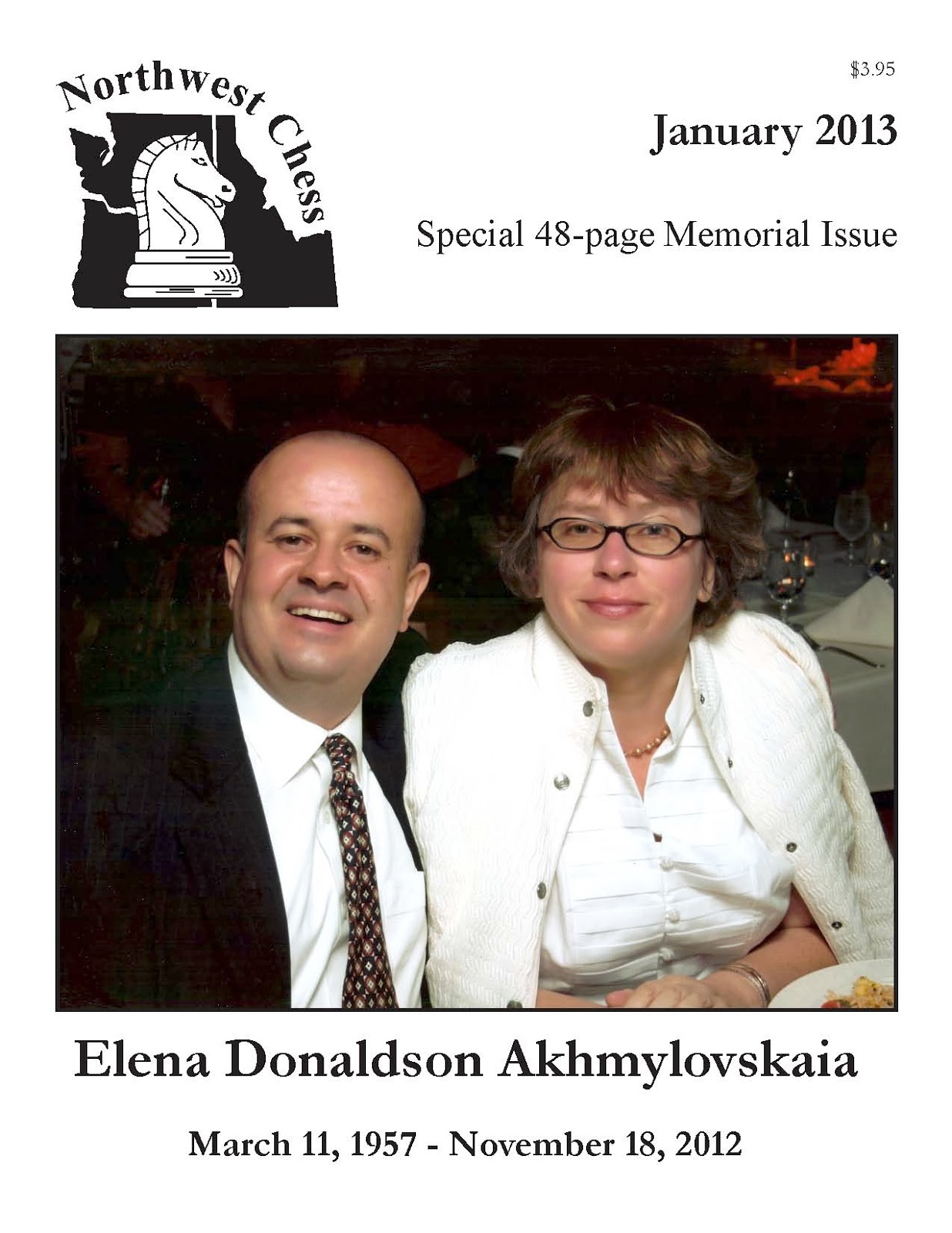
Cover: Georgi Orlov and Elena Donaldson Akhmylovskaia in August 2008. Family photo courtesy of Georgi Orlov.

This was Jeffrey Roland's second issue as Editor and my second as Assistant Editor. Note that my feature article on Elena Donaldson was also published (in a modified version) in Chess Life magazine with the benefit of further insight much polish from co-author Al Lawrence.

January 2013 Northwest Chess online color edition

Summary: 48-page special memorial issue with "Elena Donaldson Akhmylovskaia (1957-2012) by Frank Niro," "World Youth Championship (NW Players) by the players/families," "Seattle Sluggers U.S. Chess League Champions," Idaho Chess News, Washington Chess News, Oregon Chess News, and Dr. Ralph Hall Northwest Grand Prix report by Murlin Varner.

Contents:
Georgi Orlov and Elena Donaldson Akhmylovskaia.........Cover
From the Editor’s Desk by Jeff Roland...............3
Elena Donaldson Akhmylovskaia (1957-2012) by Frank Niro......4
World Youth Championship (NW Players)..............18
Seattle Sluggers U.S. Chess League Champions.....................22
Idaho Chess News..........................................................31
Washington Chess News.....................................................36
Oregon Chess News.........................................................39
Dr. Ralph Hall Northwest Grand Prix by Murlin Varner..............44
7th Annual Grand Pacific Open (Victoria, BC) Tournament Ad..46
Seattle Chess Club Tournaments and Events..........................47
Upcoming Events................................................Back Cover

Thursday, May 2, 2013

December 2012 NWC Online Color Edition

Cover: David Rupel in St. Petersburg, Russia.

This was Jeffrey Roland's premier issue as Editor and my first as Assistant Editor.

December 2012 Northwest Chess Online Color Edition

Summary: 32-page issue with Rupel Goes to Russia by David Rupel, Washington Challengers’ Cup by Frank Niro, Washington Chess News by Russell “Rusty” Miller, Book Review by IM John Donaldson, Idaho Chess News by Jeffrey Roland, Oregon Chess News by Frank Niro, and the usual Grand Prix report by Murlin Varner. 8 pages are printed in color!

Contents:

David Rupel in St. Petersburg, Russia photo credit: David Rupel as taken by an anonymous passerby.........Cover
Northwest Chess Information Page......................2
Gresham Open — Tournament Flyer/Registration Form..........3
Rupel Goes to Russia by David Rupel........................4
Washington Challengers’ Cup by Frank Niro..............7
Washington Chess News by Russell “Rusty” Miller.......11
Book Review by IM John Donaldson..................16
Idaho Chess News by Jeffrey Roland.................17
Oregon Chess News by Frank Niro.....................24
Dr. Ralph Hall Northwest Grand Prix by Murlin Varner........28
Upcoming Events...............................................30
Seattle Chess Club Tournaments and Events......................31
Western Idaho Open — Tournament Flyer..........Back Cover

Northwest Chess web site

Thursday, April 18, 2013

November 2012 NWC online color edition

Cover: The National Chess Day celebration group photograph taken in Boise, ID. Photo by Jeffrey Roland and Frank Niro. This photo also appeared in Chess Life magazine.

This was my fourth and final issue as Interim Editor.

November issue of Northwest Chess

Summary: 32-page issue with National Chess Day Events, Washington Chess News by Russell “Rusty” Miller, Idaho Chess News by Jeffrey Roland, Oregon News by Frank Niro, and a Dr. Ralph Hall Northwest Grand Prix report by Murlin Varner.

Contents:
National Chess Day in Boise.........Cover
Northwest Chess Information Page..........2
Contents, From the Publisher’s Desk............3
National Chess Day Events, October 13, 2012......4
Washington Class Championships — Entry Form....9
Washington Chess News by Russell “Rusty” Miller...10
Idaho Chess News by Jeffrey Roland...............18
Oregon News by Frank Niro....................23
Western Idaho Open — Tournament Flyer...........27
Dr. Ralph Hall Northwest Grand Prix by Murlin Varner...28
Seattle Chess Club Tournaments and Events....31
Upcoming Events.....................Back Cover

Thursday, March 14, 2013

October NWC online color edition

Cover: Steven Breckenridge; photo by Jeffrey Roland.

This was the third of my four issues as Editor.

October 2012 Northwest Chess

Summary: 48-page issue with Oregon Open report and games; Oregon Open Gallery of Past Champions; Additional U.S. Open Games and Photos; Washington News by Russell “Rusty” Miller; Emerald City Open report by Carol & Fred Kleist; Idaho News by Jeffrey Roland; Oregon News by Frank Niro; Book Review by IM John Donaldson and a Dr. Ralph Hall Memorial Northwest Grand Prix report by Murlin Varner.

Contents:

Steven Breckenridge photo credit: Jeffrey Roland..Cover
Northwest Chess Information Page......2
Contents, USPS Statement of Ownership......3
Six-Way Tie at 2012 Oregon Open.................4
Oregon Open Gallery of Past Champions........8-9
2012 Oregon Open crosstables.............11-12
30th Annual Sands Regency - Reno - Entry Form...13
Additional U.S. Open Games and Photos.....14
National Chess Day Events, October 13, 2012.....24
Washington Class Championships - Entry Form.....25
Washington News by Russell “Rusty” Miller.........26
Emerald City Open by Carol & Fred Kleist.....29
Oregon News by Frank Niro..................35
Washington Challengers Cup - Announcement.......39
Book Review by IM John Donaldson............40
Western Idaho Open - Tournament Flyer...........45
Dr. Ralph Hall Northwest Grand Prix by Murlin Varner...46
Seattle Chess Club Tournaments and Events....47
Upcoming Events.....................Back Cover

Northwest Chess web site

Thursday, February 14, 2013

Northwest Chess releases online color versions of magazine (with 3-month delay)

Cover: The picture, taken by Jeff Roland when he and Frank Niro went to Crossville, Tennessee, shows the highly dedicated USCF staff that we have all come to appreciate over the years! The black & white version of this cover was modified for mailing purposes to provide room for mailing labels.

The publishers of Northwest Chess magazine have announced the online availability of back issues of color versions of the magazine with approximately a three month delay from release date. The capability of producing color .pdf versions of the magazine originated with the introduction of new software last August.

For the record, I was the Editor of Northwest Chess from August 2012 through November 2012 and assisted in the training of the current editor, Jeffrey Roland. I served as his Assistant Editor during a short transition period.

August 2012 Issue of Northwest Chess

Summary: 48-page special U.S. Open edition produced by Editor Frank Niro and Assistant Editor Jeff Roland. Includes U.S. Open related content, an article by Frank Niro about the late Dr. Ralph L. Hall, the "Most exciting game of 2011," a reprint of Yasser Seirawan's fictional story "Hapley’s Project," Idaho chess news, a report on the Oregon Senior Championship, and a Grand Prix update.

Contents
Cover: Members of the U.S. Chess Federation Staff in front of the
U.S.C.F. offices in Crossville, TN. (left to right: Judy Misner, Joe
Wright, Joan DuBois (in the car), Traci Lee, Susan Houston, Chuck
Lovingood, Joshua Van Winkle, Cheryle Bruce, Alan Kantor, USCF
Executive Director Bill Hall. Photo credit: Jeffrey Roland
Page 3: The Publisher’s Desk...............................Duane Polich
Page 4: Letter from Mayor of Vancouver...............Timothy D. Leavitt
Page 5: U.S. Open returns to the Pacific Northwest.......Russell Miller
Page 7: 2012 U.S. Open Schedule..............................USCF Staff
Page 10: Dr. Ralph L. Hall (1930-2011).......................Frank Niro
Page 18: Most exciting game of 2011.......................Roua vs. Chen
Page 22: Hapley’s Project...............................Yasser Seirawan
Page 37: Idaho News......................................Jeffrey Roland
Page 38: Oregon Senior Championship......Frank Niro & Brian Berger
Page 42: Northwest Grand Prix.............................Murlin Varner
Page 47: Seattle Chess Club Tournaments.....................Fred Kleist
Back Cover: Upcoming Events........................Various Contributors

Thursday, November 8, 2012

McKay Tartan Book Series Update


The Monopoly Book by Maxine Brady (McKay Tartan Series #42, published in 1976). Maxine Brady is the wife of St. John's University professor Dr. Frank Brady, author of another book in the series, Profile of a Prodigy, #29. I met Frank and Maxine when Dr. Brady was on the Executive Board of the U.S.C.F. in 2002.

My quest to identify and acquire all of the titles in the McKay Tartan Books series continues. Following is an updated list, as best as I can determine at this point.

1 Fine, Reuben - Ideas Behind the Chess Openings
2 Fine, Reuben - The Middle Game in Chess
3 Fine, Reuben - Basic Chess Endings
4 Reshevsky, Sammy & Fred Reinfeld - Learn Chess Fast
5 Nimzovich, Aron; Fred Reinfeld, ed. - My System
6 Lasker, Emanuel - Common Sense in Chess
7 Chernev, Irving - Winning Chess Traps
8 Reinfeld, Fred & Irving Chernev - Chess Strategy & Tactics
9 Lasker, Edward - Modern Chess Strategy

11 Wiswell, Tom - Learn Checkers Fast
12 Kmoch, Hans - Pawn Power in Chess

17 Adams, Leon D. - The Commonsense Book of Wine
18 Alekhine, Alexander - My Best Games of Chess 1908-1923
19 Alekhine, Alexander - My Best Games of Chess 1924-1937
20 Carmer, Carl - Dark Trees to the Wind
21 Carmer, Carl - Listen for a Lonesome Drum

23 Sommervell, D.C. - English Thought in the Nineteenth Century
24 Trevelyan, George M. - English Social History
25 du Mont, J. - 200 Miniature Games of Chess
26 Fine, Reuben - A Passion for Chess
27 Capablanca, J.R. - Chess Fundamentals
28 Spielmann, Rudolf - The Art of Sacrifice in Chess
29 Brady, Frank - Profile of a Prodigy

31 Horowitz, I.A. & Geoffrey Mott-Smith - Point Count Chess
32 Napier, William E. - Paul Morphy and the Golden Age of Chess
33 Coles, R.N. - Epic Battles of the Chessboard
34 Alexander, C.H.O'D. - Alekhine's Best Games of Chess 1938-1945
35 Armanino, Dominic C. - Dominoes
36 Horowitz, I.A. - How to Win in the Chess Endings


37 Fine, Reuben - Practical Chess Openings

Col. Ed B. Edmonson, Executive Director of the U.S.C.F., made this notation in the copy of this book in the U.S.C.F. library. Apparently, he wasn't impressed...

38 Euwe, Max - Strategy and Tactics in Chess

41 Euwe, Max & Walter Meiden - Chess Master vs. Chess Amateur
42 Brady, Maxine - The Monopoly Book

44 Tarrasch, Siegbert - The Game of Chess

46 Morrison, Martin E. (ed.) - Official Rules of Chess (2nd edition)
47 Euwe, Max - The Development of Chess Style
48 Golombek, H. - Capablanca's 100 Best Games of Chess
49 Lombardy, William - Modern Chess Opening Traps

51 Soltis, Andrew - Pawn Structure Chess
52 Larsen, Bent - The World Chess Championship 1978
53 Holland, Tim - Backgammon for People Who Hate to Lose
54 Holland, Tim - Better Backgammon
55 Pachman, Ludek - Attack and Defense in Modern Chess Tactics
56 Euwe, Max - Judgment and Planning in Chess
57 Pachman, Ludek - Modern Chess Tactics

59 Bronstein, David - The Chess Struggle in Practice

61 Collins, John W. - Maxims of Chess
62 Soltis, Andrew - Catalog of Chess Mistakes

66 Mednis, Edmar - Practical Endgame Lessons

68 Korn, Walter - America's Chess Heritage
69 Korn, Walter - Modern Chess Openings (12th ed)
70 Mednis, Edmar - King Power in Chess

73 Redman, Tim (ed.) - U.S. Chess Federation's Official Rules of Chess

------------------------------------------------------------------------------

So, for those who might be curious about the origins of the board game Monopoly, here is the official authorized version (as provided by Maxine Brady):

The Setting

The stock market crash of 1929 caused mass unemployment for millions of Americans. For Charles Darrow, the financial problems grew increasingly difficult. Once a salesman of heating and engineering equipment, he spent the early 1930s looking for a job. He'd been feeding hemself, his wife, and their son by taking any odd job he could find. He repaired electric irons, did occasional fix-it jobs, even walked dogs - when he could find someone to pay him for his labors.

It wasn't enough, though. Now his wife was expecting their second child. He had to find a way to make more money.

To fill his idle hours, and help him forget his worries temporarily, Darrow invented things. Some of them were fun; others were probably devised in hopes that they would become profitable. He made jigsaw puzzles; he created a combination bat-and-ball, which was supposed to be used as a beach toy; he designed an improved pad for recording and scoring bridge games. They were interesting diversions, but nobody was willing to pay for them.

Darrow's problem, of course, was not unique. Many of his friends and family were out of jobs, and were having trouble affording even such necessities as food and shelter. For them, as for most people, the movies, the theater, and any form of entertainment which cost any money at all was too expensive.

So they got together in the evenings and on weekends, when the offices of the Federal Emergency Relief Administration were closed, and they talked. And after the gloomy recital of that day's particular troubles, the conversation would usually become nostalgic: remember the good old days?

Darrow did. For him and his wife, thinking back to the more prosperous life they had led only a few years before, some of the pleasantest memories were of the vacations they had spent at one of their favorite holiday places, a seaside resort in New Jersey called Atlantic City.

The Game

One evening in 1930, Darrow sat down at his kitchen table in Germantown, Pennsylvania, and sketched out some of the street names of Atlantic City on the round piece of oilcloth that covered the table. The streets he chose were all from the same side of the city: between the Inlet and Park Place, along the Boardwalk. When he finished, Darrow was short one name, so he choose Marven Gardens, a section from nearby Margate. Probably unintentionally, he altered the spelling, and it was penciled onto his board as Marvin Gardens.

He included the three railroads that carried the wealthy vacationers to the resort, and the utility companies that serviced them, as well as the parcels of real estate of varying prices. He wanted a fourth railroad to make his board symmetrical, so he added the Short Line: actually it was a freight-carrying bus company that had a depot in Atlantic City. A local paint store gave him free samples of several colors, and he used them to color his game board. A new game began to take form in his mind.

Darrow cut houses and hotels for his little city, using scraps of wooden molding that a lumber yard had discarded. He rounded up stray pieces of cardboard, and typed out title cards for the different properites. The rest of the equipment was fairly easy to acquire: colored buttons for the tokens, a pair of dice, and a lot of play money.

From then on, in the evenings, the Darrows would sit around the kitchen table buying, renting, developing, and selling real estate. They had little enough real cash on hand, yet The Game, as they all referred to it, permitted them to manipulate large sums of money as they engaged in complex negotiations to acquire valuable blocks of property. The simple, almost crude set exerted a continuing fascination and challenge. As friends dropped in to visit, they were invited to join the game. Soon the "Monopoly evenings" became a standard feature at the Darrow home.

Then the friends wanted to take the game home with them. Each night's winner, a bit heady with his success in the nether reaches of high finance, asked for a set of his own, so that he could show off his financial wizardry. The runner-up, convinced that he could win the next time if he could only hone his skill with a little practice, generally wanted a set too. Darrow had an overabundance of free time, so he began making copies of his board, property cards, and buildings. His delighted friends supplied their own dice and tokens, and often their own package of play money.

But the demand increased, and Darrow increased his output to two handmade sets a day. Selling them for $4 apiece, each set brought him new customers. People kept talking about the new game and playing it with their friends. Through word-of-mouth advertising alone, Darrow sold about one hundred sets, and had orders for many more. But his one-at-a-time production technique simply couldn't keep up with the demand.

Encouraged by his friends, Darrow decided to test the game outside his personal sphere of acquaintances and friends of friends. He made up a few sets and offered them to department stores in Philadelphia, the nearest city. They sold.

With the knowledge that his game was marketable, he attempted to increase his rate of production. A friend helped out by printing the Monopoly boards and the title cards. Darrow continued to paint in the colors and assemble the sets by hand. This partial automation enabled him to produce six games a day. It wasn't enough.

Parker Brothers

By 1934, now fully aware that his interesting diversion had turned into a potentially profitable business, Darrow arranged to have the same friend print and package the complete sets. It looked like they had the problem solved, for a little while. Production was finally keeping pace with sales. But they hadn't reckoned with the Philadelphia sales. Soon, a department store began ordering sets wholesale, in quantities far greater than anything they could accommodate. It became obvious to Darrow that he had only two choices. He could borrow money and plunge wholeheartedly into the game business, or he could sell Monopoly to an established game company. Darrow wrote to Parker Brothers, then as now one of the world's major game manufactureers and distributors, to see if the company would be interested in producing and marketing the game on a national basis.

Parker brothers had by then been in business for half a century, and had become accustomed to enthusiastic inventors sending in new game creations. Some of the ideas had even proven marketable, but, by and large, the company's managers tended to trust the creativity of their own staff far more than they did an unproven novice.

Although Parker Brothers thought the basic framework of the game seemed possibly interesting, they handled the game routinely. Various members of the company sat down at their offices in Salem, Massachusetts, to try it out, as they do all prospective games. They played it several times and found that they all enjoyed it. But the company had evolved a set of inviolable ground rules for "family games," which they held to be mandatory for any game that could be successfully marketed. According to the Parker precept, a family game should last approximately forty-five minutes. Monopoly could go on for hours. Parker also felt that a game should have a specific end, a goal to be achieved. (In their other board games, the players' tokens progressed around a track until they reached the end - which might be symbolized by a pot of gold, a home port, a jackpot, or even Heaven - and the first player to reach this goal was the winner.) In Monopoly, the players just kept going round and round the board. The only goal was to bankrupt the other players and emerge still solvent yourself. Furthermore, Monopoly's rules seemed far too complex to the Parker staff; they thought the general game-playing public would be hopelessly confused trying to learn how to handle mortgages, rents, and interest.

After testing the game for several weeks, Parker Brothers made the unanimous decision to reject it. The company wrote and informed Darrow of this decision, explaining that his game contained "fifty-two fundamental errors." It would never be accepted by the public.

Darrow, of course, was considerably annoyed. He knew very well how people responded to his game. Despite Parker Brothers' analysis, Monopoly was decidedly marketable. Unfortunately, however, it was far more marketable than Darrow himself; he was still unemployed. Monopoly, it seemed, was virtually his only asset.

Therefore, he went back to his printer friend, ordered the production of five thousand sets, and continued to sell the game locally. But locally included Philadelphia, and the department stores there were soon aware that Darrow was increasing his output. They began placing massive orders for the Christmas season. Darrow now found himself working fourteen hours a day just trying to keep up with the shipping.

With the game now being ordered in wholesale lots, Parker's sales representatives soon became acutely aware that the Philadelphia stores were expecting huge sales of Monopoly the following Christmas, the traditional game-buying season. Word was quickly passed back to corporate headquarters in Salem, where the issue was deemed worthy of reconsideration. Then, to top things off, a major New York toy and game store, the prestigious F. A. O. Schwarz, bought two hundred sets out of the original five thousand printing.

Shortly afterwards, a friend telephoned Saly Barton (daughter of Parker Brothers' founder, George Parker) to rave about a wonderful new game she had purchased at F. A. O. Schwarz. It was called Monopoly, and it was hard to come by and in short supply. The friend suggested that Mrs. Barton tell Parker Brothers about it. Sally did. She told her husband, Robert B. M. Barton, who happened to be the president of the company. Curious about a competitor's product, he purchased a copy of the game at F. A. O. Schwarz, took it home and wound up playing it until 1 A.M. The next day, Barton wrote to Darrow, and three days later they met at Parker Brothers' New York sales office in the Flatiron Building.

Parker Brothers offered to buy the game outright and give Darrow royalties on all sets sold. The company insisted, though, on making some revisions which would refine the game and clarify the rules. Some of the staff were still concerned about the indefinite playing time, so they agreed to market the original version as long as Darrow permitted them to develop a variation of the game which could be played in less time. This shorter version was to be printed along with the general rules, to give the public an option.

Darrow agreed and the contract was signed. Later, in explaining why he had decided to sell his brainchild, Darrow related his decision to the monetary commitment he would have otherwise had to make in order to keep producing the game himself. "Taking the precepts of Monopoly to heart," he said, "I did not care to speculate." Years afterward, commenting on the final offer from Parker Brothers, he wrote: "I gladly accepted and have never regretted that decision."

The royalties from sales of Monopoly soon made Darrow a millionaire. He retired at the age of forty-six, to become a gentleman farmer in Bucks County, Pennsylvania, a world traveler with a particular interest in ancient cities, a motion picture photographer, and a collector of exotic orchid species. In 1970, a few years after Darrow's death, Atlantic City erected a commemorative plaque in his honor. It stands on the Boardwalk, near the juncture of Park Place.

Note: This list was updated in January, 2014.